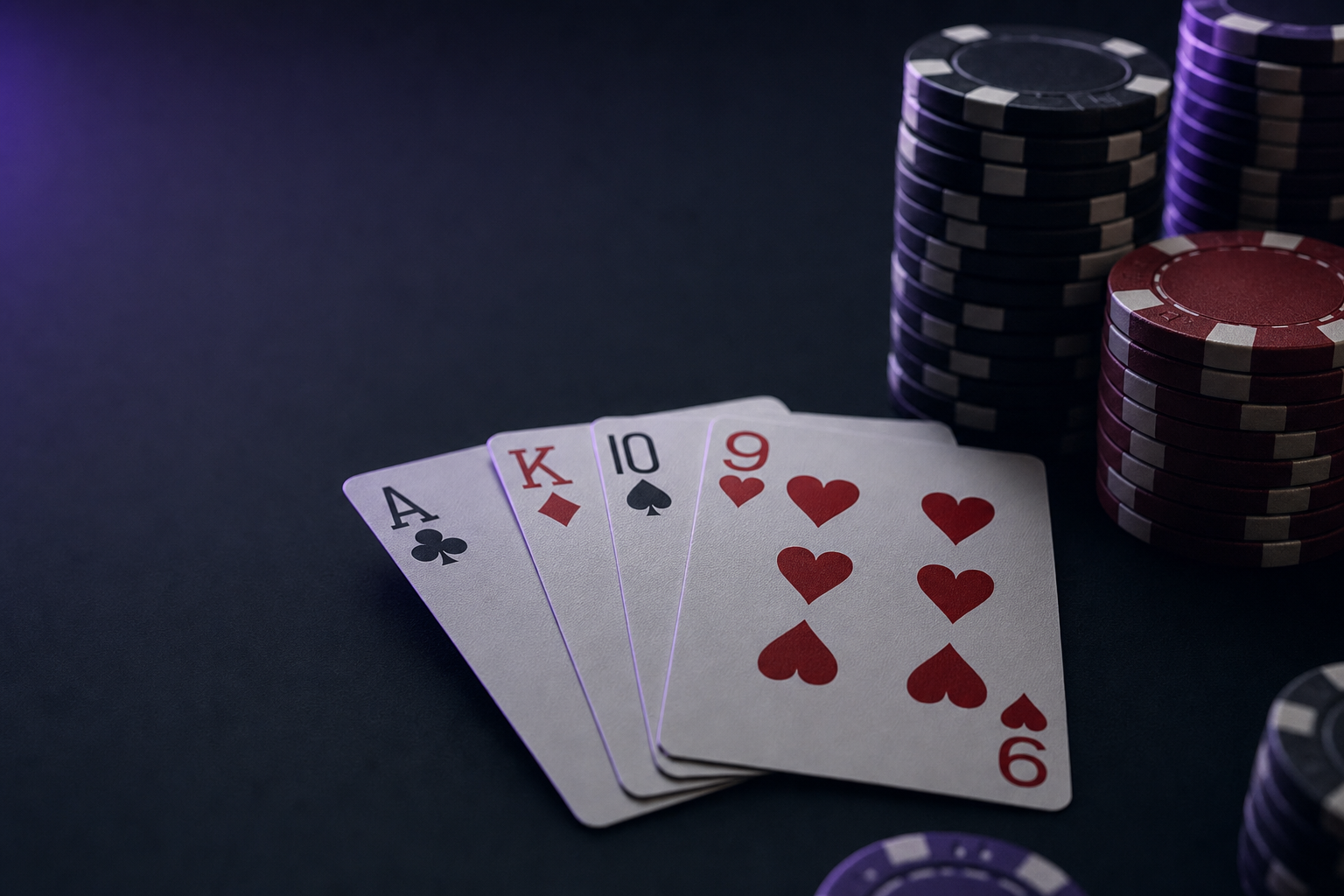
PLO tournaments punish you differently than cash. Stacks shrink. Blinds climb. And the equities that felt safe at 200bb start folding under pressure at 30. If you're bringing a cash-game brain to a PLO MTT, you're leaving chips everywhere.
Here's how to think about it, stage by stage.
What Makes PLO Tournaments Different From Cash Games?
PLO tournaments force you to play shorter stacks than you're used to. In cash, you sit down at 100bb and top up. In a tournament, you'll spend most of your time between 20 and 60bb — a range where PLO cash strategy barely applies.
Three things change:
- Stack depth shifts constantly. Your range at 80bb is not your range at 30bb. Not even close.
- You can't reload. One bad spot ends your tournament. Variance you'd shrug off in cash becomes fatal.
- ICM warps everything late. Chips you win are worth less than chips you lose near the money and final table.
The result: you play tighter, you value big pairs and connected wraps more, and you learn to fold hands you'd raise all day in a $2/$5 cash game.
How Should Your Preflop Ranges Change By Stack Depth?
Preflop strategy in PLO tournaments splits cleanly into three bands. The math is different at each one.
Deep (100bb+): Play a normal PLO cash range. Open, 3-bet, cold-call in position with double-suited rundowns and premium pairs. You have room to maneuver postflop, so speculative hands (mid rundowns, suited aces) hold their value.
Medium (40–80bb): You're in a 3-bet-or-fold zone with a lot of hands. Flat-calling raises out of position gets expensive when the SPR after the flop is 3–5 and you can't realize equity. Tighten your opens. When you play, play aggressively.
Short (20–25bb): Jam or fold. Post-flop play at this depth is a coin flip on most boards because pot commitment kicks in immediately. Hands like AAxx, KKxx with a suited king, and double-suited premium rundowns go all in. Everything else folds.
The trap for Hold'em converts: at 25bb in NLHE, you're open-raising a wide range. In PLO at 25bb, you're barely opening anything that isn't a shove candidate.
Why Do Pros Like Phil Galfond Say "Tight Is Right"?
Because PLO equities run close, and close equities are variance disasters when you can't rebuy. Phil Galfond has made this point for years — tight ranges in PLO tournaments protect you from the swings that kill your ROI.
A 60/40 favorite in Hold'em preflop is a beast. A 60/40 favorite in PLO is normal. That means every marginal spot you take is a near-flip you're paying to enter. Multiply that across a tournament, and loose players just bleed out.
Galfond also points out that PLO tournaments typically have fewer antes than NLHE. Short stacks don't get pressured to gamble by ante pressure. You can wait. So wait.
Tight doesn't mean passive. When you play a hand, play it hard. Fold pre, raise pot, 3-bet the good ones. The leak isn't aggression — it's the loose calls that put you in bloated pots with dominated equity.
What's The Bankroll Reality For PLO Tournaments?
You need over 100 buy-ins to play PLO tournaments responsibly. That's not a suggestion.
PLO cash already runs high variance. Tournaments compound it. You'll go 40 tournaments without a min-cash. You'll bust AAxx double-suited to a rundown that hit its wrap. You'll ladder to the final table and then get coolered three-handed.
If you're playing $100 tournaments, you want at least $10,000 dedicated to that stake. If that number stings, drop down. Bankroll pressure makes you play scared, and scared PLO is losing PLO.
How Do You Play The Flop In A PLO Tournament?
Flop strategy in PLO tournaments comes down to one question: do you have equity you can protect, or equity you have to gamble on?
With big pair + backup (AAxx with a suited ace, KKxx with a suited king), you want to build a pot on dry boards and pot-control on wet ones. Take AKK8 with the K8 flush draw. On a 9-6-2 rainbow, you pot it — you have the best hand and no vulnerable board texture. On a J-T-8 two-tone, you slow down. Your kings are behind wraps and combo draws, and your flush draw is second nut at best.
A hand like KK74 double-suited is a different animal. The 7-4 does almost nothing except give you two flush draws. On any board without your suits, you're just KKxx with no backup. Fold to real pressure.
With premium wraps and combo draws, get it in on the flop when you can. A 13-out wrap plus a flush draw is often 55–60% against top set. But you need the fold equity or the price to justify it — check the exact numbers on our [equity calculator](https://theplolab.com) before you commit stacks to a spot you're not sure about.
How Does Pot-Limit Betting Change Tournament Decisions?
Pot-limit betting caps your aggression, and that changes everything about SPR management.
You can't overbet to fold people out. You can't jam 3x pot on the turn to protect a set. The biggest bet you can make is pot — and by the river, if you've been building the whole way, pot is often your remaining stack anyway.
This means preflop and flop pot-building decisions determine your river SPR. If you want to get all-in by the river with your KKxx on a dry board, you need to size up early. If you want to keep the pot small with a marginal hand, you check-call the flop instead of check-raising.
The mistake is drifting. Half-committing pot builds — a min-raise pre, a half-pot flop bet — leaves you at awkward SPRs on the turn where you can't fold and can't get value.
Pick a plan on the flop. Execute it.
Frequently Asked Questions
How many big blinds is "short-stacked" in a PLO tournament?
Anything under 25bb is short in PLO. This is much shallower than the NLHE definition because PLO equities run closer — you can't get value from a small edge when a marginal call commits you. At 20–25bb, you're in jam-or-fold territory with almost every hand you play.
Should I 3-bet more or less in PLO tournaments than in cash?
Less in general, but more relative to your calling range. Flat-calling out of position at medium stack depths is a losing play because you can't realize equity when the SPR gets tight. So you fold more hands total, but the hands you do play, you 3-bet aggressively.
What hands should I jam at 20bb in a PLO tournament?
AAxx (any structure), KKxx with a suited king or connectivity, QQxx with a suited ace, and double-suited premium rundowns like JT98ds. Weaker aces without backup are close — profitable in some spots, marginal in others. Everything below QQxx without connectivity or suits is a fold.
How much of my bankroll should a single PLO tournament buy-in be?
Under 1%. You want 100+ buy-ins for the stakes you play. PLO tournament variance is brutal — 40-tournament downswings are normal, and you'll never survive them if you're playing 5% of your roll per event.
Do I play AAxx the same in tournaments as in cash?
Roughly, but you'll get it in shallower more often. AAxx double-suited is a jam at almost any stack depth in a tournament. In cash, you might flat a 3-bet with bare AAxx to control the pot; in a tournament, you'd rather 4-bet or fold and avoid the SPR trap.
How do I adjust for ICM near the bubble?
Tighten your calling ranges against jams, especially from big stacks. Chips you lose near the money hurt more than chips you win help. Keep opening and 3-betting to pressure medium stacks who can't call without risking their tournament life — that's where ICM chips come from.
Where should I practice PLO tournament spots?
Off the table. Run flop and preflop spots through our [PLO equity calculator](https://theplolab.com) between sessions so the equities become intuitive. When you know a wrap + flush draw is 58% against top set, you don't have to guess when the moment comes.