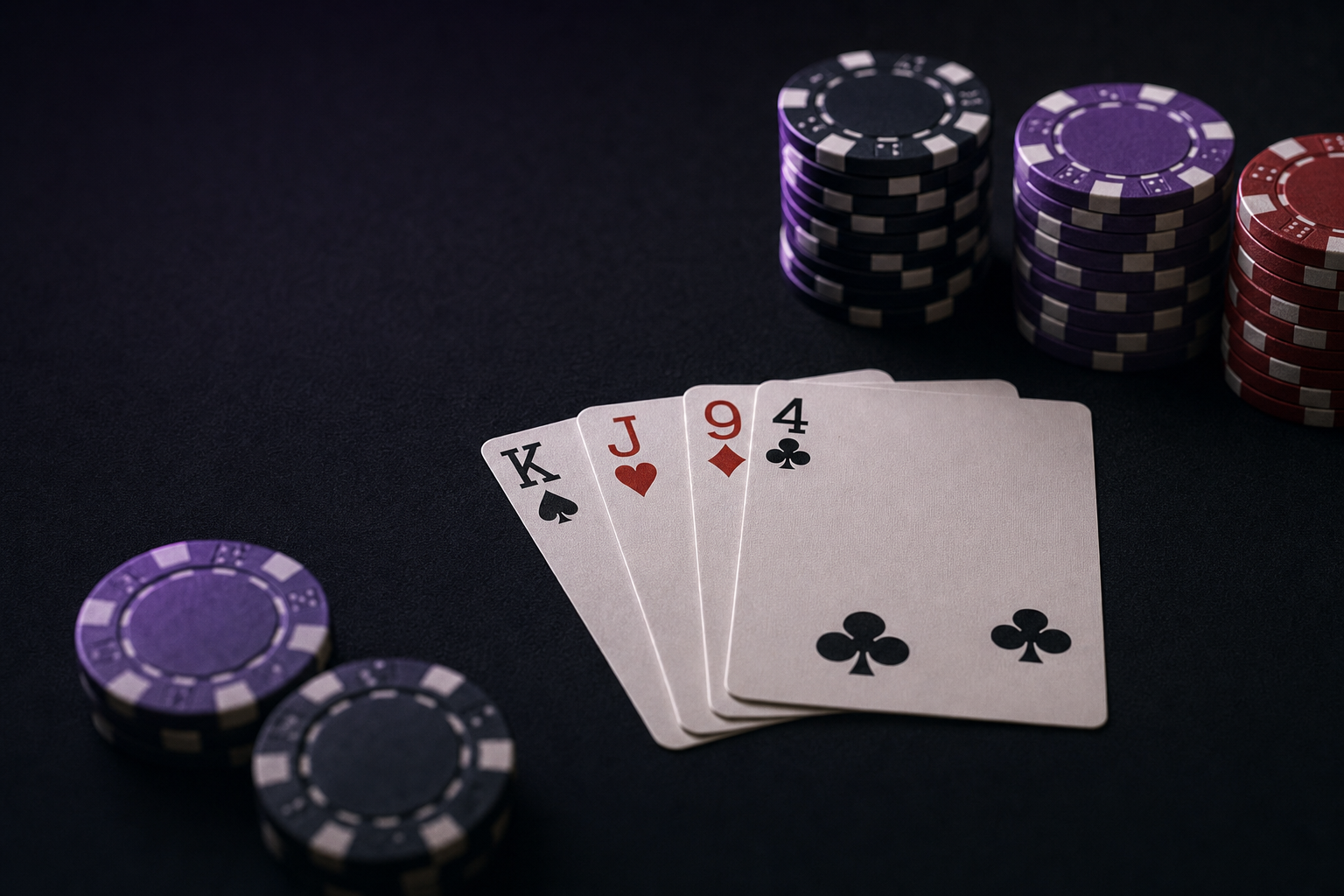
PLO strategy comes down to four ideas: play hands that make the nuts, respect stack-to-pot ratio (SPR), play more pots in position, and get to showdown with equity you actually realize. Everything else is a footnote.
If you're coming from Hold'em, the biggest shift is this: second-best is expensive. In PLO, someone usually has the nuts or a draw to it. Your whole game bends around that fact.
What is SPR and how should it guide your PLO decisions?
SPR is the effective stack divided by the pot on the flop. It tells you how committed you can get with a given hand.
Low SPR (under 3) rewards strong made hands and any hand with a redraw to the nuts. Middle SPR (3–8) is where most PLO gets played and where equity realization matters most. High SPR (over 12) punishes non-nut hands hard — you need clean equity, position, or both.
Here's the practical rule: your hand quality has to match your SPR. AAKQ double-suited is a low-SPR monster because top set with the nut flush draw plays itself. That same hand at 20 SPR out of position is a much messier hold — you make top set, someone jams the turn on a scary board, and now you're guessing.
Before you get it in preflop, ask what SPR you're creating and whether your hand wants that number.
Why is the nuts so critical on the flop?
The nuts win the biggest pots in PLO. Non-nut hands lose them.
That's not a slogan — it's the whole game. When four cards are in play, straights and flushes hit more often, and someone usually has the nut version. A king-high flush in Hold'em is a monster. In PLO, it's a hand that stacks you.
On every flop, run three checks:
- What's the nut hand right now?
- What draws to the nuts?
- Do you have either?
If the answer to the third question is no, you're bloating a pot you don't want to bloat. Bet-sizing, calling, and raising all flow from this read.
This is where a good equity calculator earns its keep. Punch the spot into The PLO Lab equity calculator once and you'll see how quickly your "strong" hand becomes a bluff-catcher when villain's range is nut-heavy.
What are the most common mistakes new PLO players make?
Six mistakes cover most of the leaks:
- Overvaluing bare AAxx. Aces with no side cards are a hand you want to raise once and give up on if you miss. AA72 rainbow is not AAKQ double-suited. Treat them differently.
- Playing dangler-heavy hands. A dangler is a card that doesn't connect to the other three. AAK2 rainbow is really just AAK — the 2 does nothing. You're playing a three-card hand against people playing four.
- Ignoring position. More on this below, but folding marginal hands out of position is almost always right.
- Chasing non-nut draws. A jack-high flush draw on a two-tone board is a trap, not an opportunity.
- Poor equity realization. Having 45% equity means nothing if you fold to the turn barrel every time. Hands out of position realize less equity than the raw number suggests.
- Not thinking about SPR before the flop. You should know roughly what pot geometry you're building before you click call.
The fix for all six is the same: slow down preflop and pick hands that want to see flops.
How do PLO hand rankings differ from Hold'em?
Everything shifts up. What wins in Hold'em loses money in PLO.
- Top pair, top kicker is a bluff-catcher, not a value hand.
- Two pair is often drawing to two outs against a made straight or set.
- Non-nut straights get coolered by higher straights constantly.
- Non-nut flushes get coolered by nut flushes.
- Sets are strong but vulnerable — you need a redraw to feel great.
- Wraps (13+ out straight draws) are among the most powerful hands in PLO, often favored over top set.
The mental adjustment: stop counting made hands, start counting nut hands and nut draws. A hand's value in PLO is roughly "how often can I make the actual best hand by the river?"
That's why double-suited, connected, high-card hands print. AAKQ double-suited can make the nut flush in two suits, the nut straight, top set, and Broadway. That's four separate paths to a hand that gets paid. A hand like KK74 double-suited is a step down — [PLO Lab solver] flags the K-high flush draws as the real selling point because the 7-4 side contributes almost nothing else.
How do you build a preflop 4-bet range in PLO?
Use four filters, in this order:
- Pair or blocker quality. Do you have aces, kings, or strong blockers to villain's 3-bet range? AAxx and KKxx are your foundation.
- Nut-suit quality. Suited to the ace beats suited to the king. Suited to the king beats offsuit. Double-suited beats single-suited.
- Connectivity. Do your side cards make straights? AAJT double-suited is a monster. AA72 is a bluff-4-bet at best.
- Low-SPR fit. After 4-betting, SPR will be low. Does your hand want that? Sets, wraps, and nut flush draws love low SPR. Bare pairs hate it.
A hand that clears all four filters is a value 4-bet. A hand that clears two or three might be a bluff or a call. A hand that clears one is a fold.
AKK8 with a K-high flush draw is a good example of the middle zone. Kings, decent blocker to aces, a nut-adjacent flush draw — but the 8 is a partial dangler. [PLO Lab solver] mixes this one depending on stack depth and opener position.
Why does position matter more in PLO than in NLHE?
Position is worth more in PLO because equities run closer and decisions are more complex.
In Hold'em, a 60/40 favorite is a big edge. In PLO, most flop matchups are 55/45 or closer. When equities are tight, whoever acts last controls the pot. That's you when you're in position.
Position lets you:
- Realize your equity. You get to see what villain does before committing.
- Control pot size. Check back turns with marginal hands. Bet flops when checked to.
- Bluff more credibly. Your range is stronger in position, so your bluffs get respect.
Practical adjustment: tighten your out-of-position ranges hard, especially from the blinds. Loosen up on the button. The button prints in PLO — more than it does in Hold'em.
What should a beginner's PLO framework look like?
Keep it simple. Five rules will take you further than any advanced concept:
- Play hands that can make the nuts. Double-suited, connected, high-card.
- Fold more out of position. Especially from the blinds.
- Check the board texture before betting. What's the nut hand? Do you have it or draw to it?
- Think about SPR before you call preflop. Where will this pot be on the flop?
- Don't stack off with non-nut made hands in big pots. King-high flush is a bluff-catcher, not a value hand.
Drill those five and you'll beat most live PLO games. The rest is refinement.
Frequently Asked Questions
What's the biggest difference between Hold'em and PLO strategy?
Nut equity. In Hold'em, top pair top kicker is a value hand. In PLO, it's a bluff-catcher. Everything in PLO strategy — hand selection, bet sizing, when to commit — flows from the fact that someone usually has the nuts or a draw to it. If your hand can't make the nuts, you shouldn't be building big pots with it.
How tight should I play preflop in PLO?
Tighter than you think, especially out of position. From early position, fold anything with a dangler or no suits. From the button, you can open wider — position lets you realize equity that would be dead money out of position. The blinds are the tightest seats in PLO, not the loosest.
Why do I keep losing with AAxx?
Bare aces without side cards or suits are a raise-and-give-up hand. AA72 rainbow flops well less than 20% of the time. You're not supposed to stack off with it postflop unless the board is very friendly. The fix: three-bet, c-bet a good flop, and let it go when you miss.
What is a wrap and why does it matter?
A wrap is a straight draw with 13 or more outs — created when your hole cards wrap around the board's connectors. Wraps are often favored against top set on the flop. If your hand can make wraps (connected middle cards like JT98), you have real equity even when you don't flop a made hand.
How do I know when to commit my stack in PLO?
Two conditions: low SPR with a strong made hand, or a hand with a redraw to the nuts. Top set with a nut flush draw is a snap-jam in most spots. Top set on a wet board with no redraw is a fold-if-raised situation. The nuts right now plus a redraw to a better nuts is the sweet spot.
Should I bluff a lot in PLO?
Less than in Hold'em. Ranges are wider and equities run closer, so people call more. Your best bluffs have blockers to villain's value range and equity if called — bare air bluffs get picked off. Semi-bluff with draws, not with nothing.
How do I get better at PLO faster?
Review your hands. Not just the ones you lost — the ones you weren't sure about. Run them through The PLO Lab hand analyzer and see how your line held up. Ten reviewed hands a week will teach you more than a hundred played hands you never think about again.