How to Play Wraps in PLO (Pot Limit Omaha)
A wrap is a straight draw in PLO with 9 or more outs — and the biggest ones have up to 20. That's more than double Hold'em's 8-out open-ender. Wraps are the engine of PLO. You play them fast, semi-bluff with them, and get money in when you flop a big one. The catch: not every out makes the nuts. Count the outs that win, not the outs that just make a straight, and you'll know whether you have a monster or a trap.
What Is a Wrap in PLO?
A wrap is a straight draw where your four hole cards "wrap around" the board cards, giving you far more outs than a normal straight draw. You use two of your hole cards plus the board, and because you hold four connected cards, multiple ranks complete your straight.
In Hold'em, the best straight draw is the open-ender — 8 outs. In PLO, a wrap can have 9, 13, 17, even 20 outs.
That's the whole reason connected hands matter so much in PLO. Four cards that run together flop wraps. Four scattered cards don't.
How Many Outs Does a Wrap Have?
Wraps range from 9 outs to 20 outs, depending on how your cards connect to the board. The more of your four cards that touch the board's middle, the more outs you get.
A rough scale:
- 9–10 outs — A small wrap. Still better than a Hold'em open-ender.
- 13 outs — A strong wrap. You'll complete it roughly half the time by the river.
- 17 outs — A big wrap. You're a favorite to make your straight.
- 20 outs — The maximum. You hit by the river the large majority of the time.
The exact count depends on the board. This is the part players guess at and get wrong, which is why the equity calculator earns its keep here.
Are Wraps Better Than a Set in PLO?
The biggest wraps are a favorite over top set on the flop. A 17-to-20-out wrap will get there often enough that getting all-in against a made set is a profitable spot, not a gamble.
Smaller wraps aren't. A 9-out wrap against a set is an underdog. A 13-out wrap is roughly a coin flip.
So the question isn't "do I have a wrap." It's "how big." Counting outs is the difference between piling money in correctly and stacking off as a 35% dog.
How Do You Play a Wrap After the Flop?
Play big wraps fast — bet and raise. With 17 to 20 outs, you have a draw that's a favorite, so build the pot and get money in while you're ahead.
Semi-bluffing wraps is where PLO pots get won. You're rarely drawing dead, you have fold equity, and when you get called you still hit a huge share of the time.
With a smaller wrap, slow down. A 9-out wrap is a draw, not a hand to stack off with. Take a card cheaply if you can, and pot-control instead of bloating the pot as an underdog.
Position helps a lot. In position, you control the price on every street and realize more of your equity. Out of position, lean toward checking smaller wraps and saving the aggression for the big ones.
What's the Difference Between a Wrap and an Open-Ender?
An open-ended straight draw has 8 outs. A wrap has 9 or more — and that gap is the whole advantage of PLO.
The open-ender uses one card on each end of a run. A wrap uses your extra connected cards to add outs above and below the board, plus the in-between ranks. More cards complete you, so your equity jumps.
If you're counting your PLO draw like a Hold'em draw, you're undercounting. That's the most common reason players misplay wraps — they see "a straight draw" and don't realize they have 16 outs.
Which Hands Flop the Most Wraps?
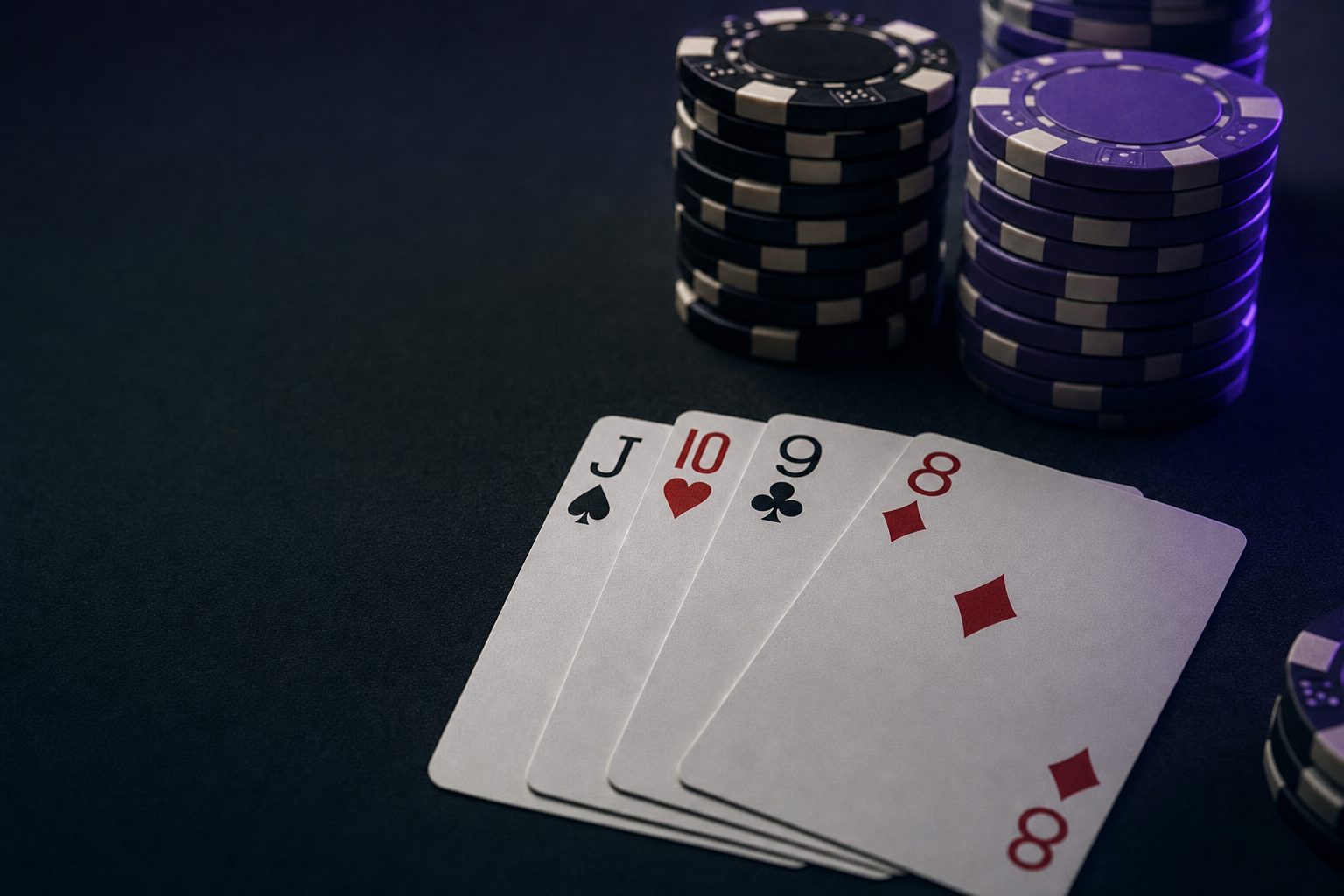
Rundowns flop the most wraps — four connected cards like J♠T♥9♠8♥, Q♣J♦T♣9♦, or 8♦7♣6♠5♥. The tighter the connection, the more wraps you flop.
The strongest wrap-makers:
- Connected, no gaps — KQJT, QJT9, JT98. Maximum wrap potential.
- One-gap rundowns — KQJ9, JT97. Still flop big wraps often.
- Double-suited rundowns — A clean rundown with two suits is a premium PLO hand, because you flop wraps and nut flush draws.
A double-suited rundown is one of the few hand types that plays better than aces in the right spot. It wants multiway pots, where its draws get paid.
Are All Wrap Outs to the Nuts?
No — and this is where wraps get players stacked. Some of your outs make the nut straight. Others make a straight that loses to a bigger one.
Count your nut outs separately. A wrap with 17 outs but only 8 of them to the nuts is weaker than it looks. The other 9 can make you the second-best straight — and in PLO, second best pays off the winner.
Low wraps are the usual trap. You flop a pile of outs on a middling board, make your straight, and run into a higher straight or a flush. The fix is discipline: lean hardest on wraps where most of your outs are to the nuts, and play the non-nut ones with more caution.
How to Practice Wraps with The PLO Lab
Wraps are pure math, and the math is too fast to do at the table. The PLO Lab equity calculator turns a guess into a number.
Try this:
- Enter a rundown like J♠T♥9♠8♥ against a set on a board where you flop a wrap
- Read the real equity — then change one board card and watch it swing
- Do it again with a non-nut wrap and see how much your equity drops when your outs aren't clean
A few minutes of this rewires how you count outs. You stop seeing "a straight draw" and start seeing 12 outs or 19 outs — and you start knowing which ones win.
The trainer takes it further, dealing you wrap spots and grading your decision against the solver. Drill it until counting outs is automatic.
Frequently Asked Questions
What is a wrap in PLO?
A wrap is a straight draw where your four connected hole cards wrap around the board, giving you 9 to 20 outs. It's the most powerful straight draw in poker — far bigger than Hold'em's 8-out open-ender.
How many outs does a big wrap have?
The biggest wraps have up to 20 outs. A 17-to-20-out wrap is a favorite to complete by the river and a favorite over top set on the flop. Smaller wraps of 9 to 13 outs are weaker, ranging from underdog to coin flip against a set.
Are wraps better than a set in PLO?
The biggest wraps (17–20 outs) are a favorite over top set on the flop, so getting all-in is correct. Smaller wraps are underdogs. The size of the wrap decides whether you stack off or slow down.
Which hands flop wraps?
Rundowns — four connected cards like JT98 or KQJT — flop the most wraps. The tighter the connection, the more often you flop a big one. Double-suited rundowns are premium because they flop wraps and flush draws together.
What's the difference between a wrap and an open-ender?
An open-ender has 8 outs. A wrap has 9 or more, because your extra connected cards add straight outs above, below, and between the board ranks. That extra equity is the core advantage of PLO over Hold'em.
Why do players misplay wraps?
They count PLO draws like Hold'em draws and undercount their outs, or they stack off with non-nut wraps and lose to a bigger straight. The fix is counting your nut outs separately and knowing the size of your wrap before you commit.