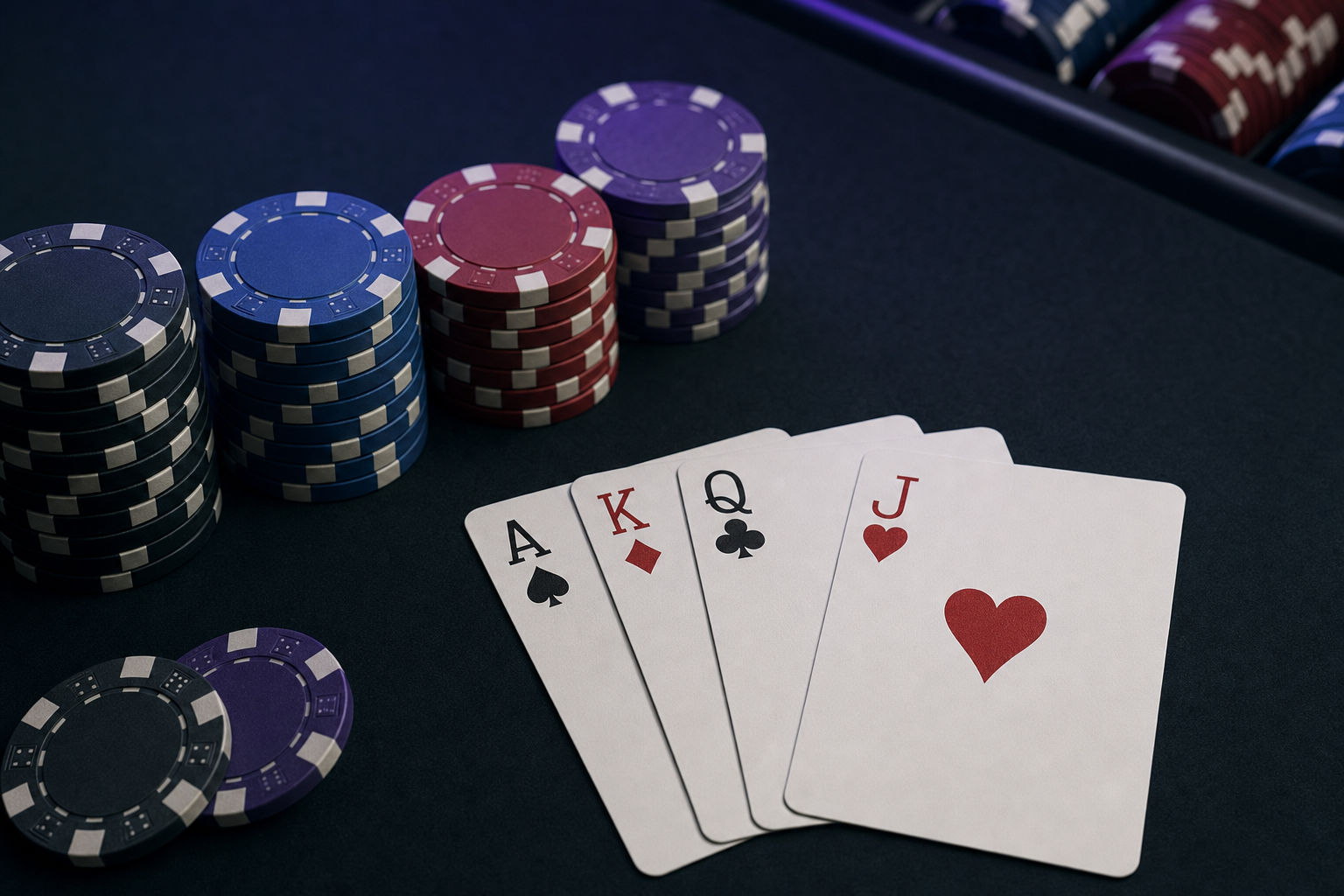
How to Play PLO Poker (Pot Limit Omaha): Rules, Betting & Beginner Strategy
PLO (Pot Limit Omaha) is a poker variant where each player is dealt four hole cards and must use exactly two of them — plus exactly three community cards — to make the best five-card hand. That one rule changes everything compared to Texas Hold'em. You don't get to use one card from your hand, or three, or all four. Exactly two. Always.
What Is Pot Limit Omaha (PLO)?
PLO is the world's second most popular poker format after No-Limit Texas Hold'em. It's a community card game played with a standard 52-card deck. Each player gets four private hole cards. Five community cards are dealt in three rounds — the flop (3 cards), the turn (1 card), and the river (1 card).
The "Pot Limit" part means you can only bet up to the size of the current pot. No shoving all-in preflop for 10x the pot. The betting is capped, which makes pot-building more methodical.
At showdown, you must use exactly 2 of your 4 hole cards and exactly 3 community cards. Not one, not three — two. If the board shows four hearts and you hold one heart, you do not have a flush. You need two hearts in your hand.
How Does the "Exactly 2 Cards" Rule Work?
This is the rule that trips up new PLO players constantly. Your best hand is always made from exactly 2 hole cards + exactly 3 community cards.
Quick check: Before you read your hand, ask "which 2 of my 4 hole cards am I using?" If you can't answer that, you're misreading your hand.
How Does Pot Limit Betting Work in PLO?
In PLO, the maximum bet at any point is the current pot size.
Preflop example at a $2/$5 game:
- Pot starts with blinds: $7 ($2 + $5)
- You want to raise from UTG. Max raise = call the $5 blind + raise the pot
- Your call makes it $12 pot. You can raise up to $12
- So your raise is $5 (call) + $12 (pot raise) = $17 total
At a live table, just ask "how much is the pot?" and bet that amount.
Pot-limit betting creates pot geometry that forces decisions faster than you'd expect. By the river, even a small preflop pot can escalate to a stack-off.
How Many Cards and Starting Hands Are There in PLO?
Every player gets 4 hole cards. PLO has 270,725 possible starting hand combinations — compared to just 1,326 in Texas Hold'em. That's 204x more. You can't intuitively know how your specific 4-card combo performs without running the numbers.
What Are the Basic Rules of PLO?
PLO follows the same structure as Hold'em with four rounds of betting:
- Preflop — Everyone gets 4 hole cards face down. Action starts left of the big blind.
- The Flop — Three community cards dealt face up. Betting round starts left of the button.
- The Turn — One more community card. Another betting round.
- The River — Fifth and final community card. Final betting round, then showdown.
At showdown: Each player makes their best 5-card hand using exactly 2 hole cards + exactly 3 community cards. Best hand wins.
How Is PLO Different From Texas Hold'em?
The structure is nearly identical — same betting rounds, same community cards, same hand rankings. But the feel is completely different.
- Hole cards: 4 in PLO vs. 2 in Hold'em
- Starting combos: 270,725 vs. 1,326
- Must-use rule: Exactly 2 hole cards in PLO vs. 0, 1, or 2 in Hold'em
- Typical equity advantage: 60-70% in PLO vs. 80%+ common in Hold'em
- Betting: Pot-limit vs. no-limit typically
- Average pot sizes: Large in PLO vs. moderate in Hold'em
The biggest adjustment: Equity runs much closer in PLO. Even premium hands like AA are rarely above 70% against a reasonable range. Variance is higher.
The second biggest adjustment: Nut draws matter enormously. Drawing to the second-best flush or the low end of a straight is a disaster in PLO.
What Are the Best Starting Hands in PLO?
The best PLO starting hands share three qualities: high cards, connectivity, and suitedness.
The single best starting hand is A♠A♥K♠K♥ — double-suited aces and kings (~73% vs. random).
Strong starting hand categories:
- Double-suited aces — highest pair + nut flush potential
- Rundowns — four consecutive or near-consecutive cards like K-Q-J-T double-suited
- Double-paired high hands — KK-QQ, QQ-JJ with suitedness
- Aces with connectivity — AA-JT suited connects aces to a rundown
Hands that look strong but often aren't:
- Rainbow hands — no suited cards means no flush equity
- Gapped rundowns — J-9-7-5 has gaps that reduce straight outs dramatically
- Bare aces — A-A-7-2 rainbow is much weaker than it appears
What Are the Common Mistakes Beginners Make in PLO?
- Overvaluing bare aces preflop — AA-72 rainbow runs maybe 55% against a solid PLO hand. Adjust expectations.
- Drawing to second-nut flushes — If someone holds the A♥ and you hold K♥, you're drawing to lose a big pot.
- Misreading hands at showdown — The exactly-2-cards rule causes constant confusion for new players.
- Playing too many hands preflop — 270,725 combos means most of them are junk.
- Underestimating pot size on the flop — PLO flops can offer excellent odds on combo draws. Potting draws for value and protection is often correct.
How Does PLO Fit in a Casino or Live Game?
Live PLO cash games are most commonly spread at $1/$2, $1/$3, $2/$5, and $5/$10. PLO is growing rapidly in cardrooms across Texas, Las Vegas, Florida, and California.
Stack sizes matter more in PLO than Hold'em. 200-300bb deep is where PLO really opens up strategic complexity.
A reasonable starting bankroll for live PLO: 300 big blinds minimum, 500bb for comfort. PLO runs higher variance than Hold'em — you need the cushion.
Do You Need a PLO Calculator to Play?
No — but you'll improve faster with one. A calculator helps you understand:
- Hand vs. hand matchups — How does your hand actually do against typical holdings?
- Equity on draws — Is this draw worth a pot-sized bet?
- Starting hand evaluation — Learn which hands are genuinely strong vs. which ones feel strong
Start Here
PLO has a real learning curve — but most of the confusion lives in those first few sessions before the exactly-2-cards rule becomes automatic. Once it clicks, the game opens up.
The fundamentals are straightforward: connected hands beat disconnected ones, nut draws beat non-nut draws, and position matters just as much as it does in Hold'em.
Start simple. Learn which 4-card combinations are actually strong. Check your equity often. And when you're not sure if a hand is profitable — run the numbers.