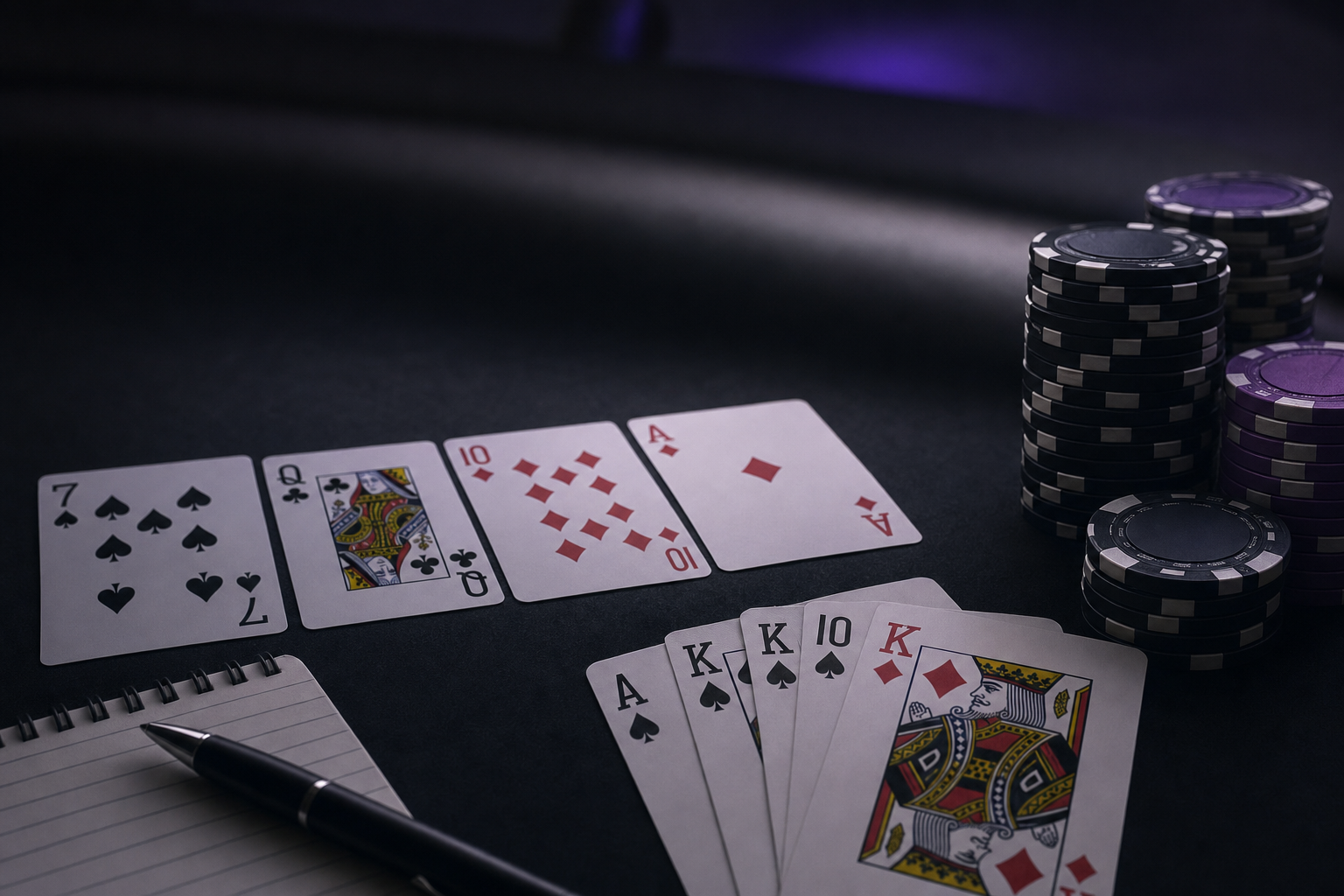
The Hold’em Habits That Get Live PLO Players Stacked
A lot of live PLO pain is not really a PLO problem.
It’s a Hold’em hangover.
Players come into PLO with instincts that used to work in 2-card poker: limp and see one, get attached to overpairs, convince themselves top two is huge, chase pretty-looking draws, and call because the pot already feels too big to surrender.
That mindset gets expensive fast in live PLO because the game is usually loose, multiway, and full of second-best disasters. More players see flops. More hands share equity. More turns and rivers rearrange the nuts. And the hands that look “good enough” in Hold’em often become stack-off traps in Omaha.
The fix is not to become scared money.
The fix is to start judging hands by coordination, nut potential, position, and equity realization instead of by raw card quality.
Why do Hold’em instincts fail so badly in live PLO?
Hold’em instincts fail in live PLO because Omaha punishes medium-strength hands much harder.
In Hold’em, one big pair can carry real weight. In PLO, one-pair hands shrink fast, two pair is more fragile than people think, and many draws look stronger than they really are because they are drawing to second-best outcomes.
That gets even worse live, where pots go multiway and people enter too many hands. Once 3 or 4 players see a flop, your hand does not just need equity. It needs clean equity. It needs to make the kind of hand that can survive action, not just touch the board.
That is the big mental shift:
In live PLO, “I connected” is not enough. You need to ask what kind of hand class you are actually building toward.
The first leak: entering too many pots passively
This is the leak that quietly poisons the whole hand.
Live players talk themselves into bad entries all day:
- “I’m closing the action.”
- “It’s only one more blind.”
- “The game is soft.”
- “I have an ace.”
- “I’m double-suited.”
The problem is that many of these hands do not actually play well after the flop, especially multiway.
A hand like A-J-6-2 with one good suit may look playable because it has an ace and some suitedness. But the hand is not coordinated. It flops weak top pairs, awkward two pair, dominated flushes, and bluff-catchers that are hard to realize out of position.
That is very different from a hand where the 4 cards actually work together. Connectedness matters. Side-card quality matters. Suits matter more when they support the whole hand, not when they are just decorative.
What better live PLO preflop thinking sounds like
Instead of asking, “Can I get in cheap?” ask:
- What nuts can this hand realistically make?
- How often will I realize my equity multiway?
- If I make a flush or straight, how often am I still in trouble?
- Does this hand play well from this position?
That one shift kills a lot of bad live PLO starts.
If the hand mostly makes weak pairs, weak flushes, and dominated straights, the price is not actually good. It is just familiar.
The second leak: bringing limp-call logic from soft Hold’em games
This one is brutal because it feels low risk.
In small and medium live games, players often treat preflop passivity as harmless. But in PLO, passive entry creates the exact kind of pot structure that punishes weak ranges most:
- more players to beat
- lower equity realization
- more dominated draws
- less initiative
- more reverse implied odds
And at lower stakes, there is another tax: rake.
If you enter passively with junk or marginal hands, you are not just taking a slightly weaker line. You are letting the rake and the multiway structure grind you down before you even make a postflop error.
That does not mean you must start blasting every hand. It means your default should stop being curiosity.
A good practical rule for live players:
If a hand needs perfect conditions to be profitable, it probably is not a real continue.
The third leak: overvaluing overpairs and naked medium-strength made hands
This is maybe the most expensive Hold’em carryover of all.
Live PLO players constantly get married to hands like:
- overpairs without backup
- top and bottom two pair
- weak top two on coordinated boards
- bottom set on ugly textures
- non-nut straights
- weak flushes
These hands are not worthless. But they are often way too weak to play for stacks once money starts piling in.
That is the part many live players resist. They do not want to hear that top two can be fragile, or that a made straight can still be a mess, or that an overpair plus redraw is not automatically a fist-pump continue.
But that is exactly how Omaha works.
When there is heavy action, ask a better question than “How strong is my hand right now?”
Ask:
How strong is my hand class against the range that continues aggressively here?
That question saves real money.
The fourth leak: confusing “a draw” with “a good draw”
Hold’em players see pair-plus-draw, flush draw, or straight draw and feel alive.
In PLO, that instinct needs a hard reset.
With 4 hole cards in play, draws are everywhere. That means many of them are dirty, dominated, or drawing to hands that cannot stand serious action.
The dangerous live examples are predictable:
- jack-high or ten-high flush draws in multiway pots
- bottom-end straight draws
- weak wraps with ugly removal
- pair plus weak draw hands that look “too connected to fold”
- made straights with obvious redraw problems
The trap is not that these hands have no equity.
The trap is that they have the wrong kind of equity for bloated live pots.
If you hit and still lose a big pot too often, your draw is not premium just because it has a lot of outs on paper.
Why live PLO makes this worse than online
Live PLO adds 3 things that make Hold’em instincts even more dangerous:
1. More multiway pots
The more players in the hand, the less excited you should be about medium-strength hands and non-nut draws.
2. More honest lines
In many live lineups, players are not finding enough aggressive bluffs in big pots. That means when they keep building on connected boards, you should downgrade the one-way hands that used to feel automatic.
3. More emotional calling
Live players hate folding after “investing.” That creates the classic PLO leak of continuing because the pot is big rather than because the hand is good.
That is not pot-odds discipline. That is sunk-cost poker.
A cleaner live PLO framework
If you want a simple way to play better immediately, use this framework at the table:
Before the flop
- Favor connected, coordinated hands over pretty disconnected ones
- Value side-card quality, not just your top 2 cards
- Tighten up when you are likely to go multiway
- Respect position more than the table atmosphere encourages
- Stop treating passive entry as harmless
After the flop
- Downgrade overpairs fast on dynamic boards
- Do not stack off lightly with weak two pair or naked sets
- Be suspicious of non-nut flushes and lower-end straights
- Ask whether your draw makes the nuts or just a hand
- When the action gets serious, think in hand classes, not emotions
The fastest way to improve your live PLO results
Stop trying to win every pot with medium-strength hands.
That is the whole article.
Most live PLO improvement is not about becoming a wizard. It is about becoming harder to stack with second-best ideas.
You do not need to become ultra-tight. You do not need solver speeches in your head. You do need to stop importing Hold’em hand values into a game where nuttiness and coordination run the economy.
If your sessions feel chaotic, start here:
- Fold more of the pretty garbage preflop.
- Enter fewer pots passively.
- Stop over-celebrating one-pair, two-pair, and weak made hands.
- Be much more selective about which draws deserve real money.
Do that first.
Your results will usually look less “swingy” long before your strategy looks fancy.
Frequently Asked Questions
What is the biggest Hold’em habit that hurts live PLO players?
The biggest bad habit is overvaluing medium-strength hands. That usually starts preflop with loose passive entries and continues postflop with overpairs, weak two pair, and non-nut draws that should not be treated like stack-off hands.
Should you limp more in soft live PLO games?
Usually no. Soft games tempt players into passive entry, but that often creates the exact multiway spots where weak hands realize equity poorly. Soft does not mean structure stops mattering.
Are overpairs strong in live PLO?
Not by default. Overpairs can have value, especially with strong backup, but naked overpairs lose value quickly on coordinated textures and in multiway pots.
Is top two pair a strong hand in PLO?
It is a made hand, not an automatic stack-off. In Omaha, top two becomes vulnerable quickly when boards are coordinated and ranges are wide.
Why do weak flush draws lose so much in live PLO?
Because they often make second-best flushes in multiway pots. In Omaha, many players arrive with suited combinations, and the bigger the pot gets, the more dangerous dominated flushes become.
What should live PLO players focus on first?
Start with preflop hand quality and passive-entry discipline. If you fix what kinds of hands you bring to the flop, many of the ugliest postflop spots disappear on their own.