Best PLO Starting Hands: Pot Limit Omaha Preflop Rankings Explained
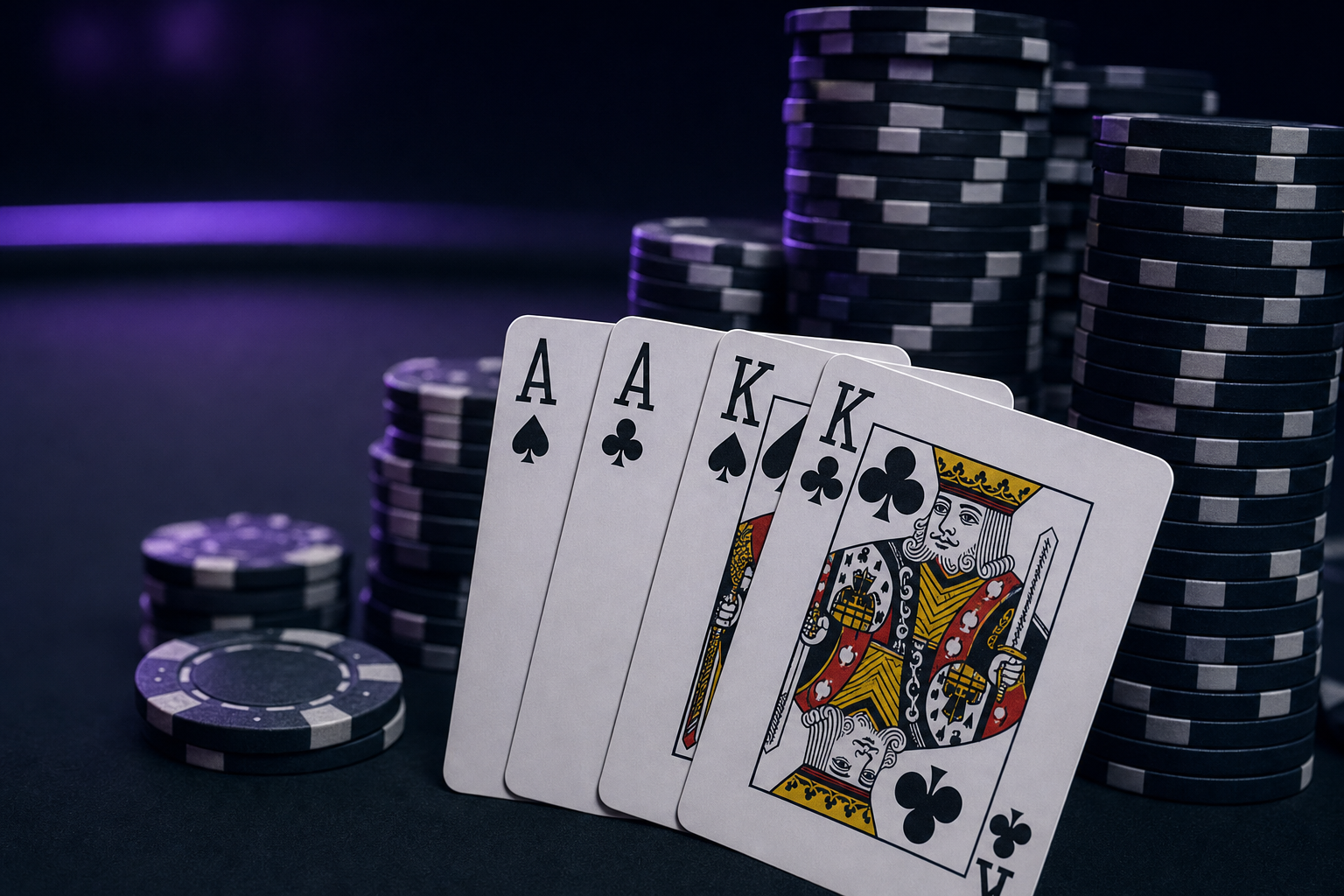
The best Pot Limit Omaha (PLO) starting hand is A♠A♥K♠K♥ — double-suited aces with kings. It combines the highest pair with the second-highest pair, nut flush equity in two suits, and Broadway straight draws. Against a random PLO hand, it wins approximately 73% of the time. Most strong PLO starting hands share a pattern: high cards, connectivity, and suits that work together. The rest — the 270,725 other combinations — fall somewhere between playable and garbage.
What Makes a PLO Starting Hand Strong?
Strong Pot Limit Omaha starting hands have three things working together: high raw card value, connectivity between all four cards, and suits that create nut-flush potential.
The key word is together. Four cards that work independently are weak. Four cards that work as a system are strong.
The three qualities every strong PLO hand needs:
- High card value — Broadway cards (A, K, Q, J, T) generate nut straights and top-pair holdings
- Connectivity — Cards within 1-4 ranks of each other create wrap draw potential on the flop
- Suits — One or two suited combinations (ideally with the ace) create nut flush draws
A hand like A♠K♠Q♥J♥ scores on all three. It's connected across four ranks. It has a nut spade flush draw and a near-nut heart flush draw. It makes the nut straight with any T, 9, 8, or 7 — that's four different straights involving all four hole cards. This is what coordinated looks like.
A hand like A♠K♦7♣3♥ has two high cards but no connectivity and no flush draws. The ace and king might help you flop top pair — but in PLO, top pair without strong backup is a way to bleed chips, not win them.
One rule that separates average PLO players from good ones: Stop looking at your best two cards. Evaluate all four — and specifically, how they interact with each other.
The Top 10 Best PLO Starting Hands
These are the strongest Pot Limit Omaha starting hand types, ranked by equity strength and playability. All equity estimates are vs. random opponent hands.
- 1. Double-suited AAKK (A♠A♥K♠K♥) — ~73% equity. Nut pair, nut draws, Broadway.
- 2. Double-suited AAQQ (A♠A♥Q♠Q♥) — ~71% equity. Nut pair, two nut flush draws.
- 3. Double-suited AAJJ (A♠A♥J♠J♥) — ~69% equity. Nut pair, Broadway draws.
- 4. Double-suited AAKQ (A♠A♥K♠Q♥) — ~68% equity. Nut pair, nut flush, Broadway.
- 5. Double-suited AAKJ (A♠A♥K♠J♥) — ~67% equity. Nut pair, nut flush, Broadway.
- 6. Single-suited AAKK (A♠A♥K♠K♦) — ~67% equity. Nut pair, strong connectivity.
- 7. Double-suited KQJT (K♠Q♠J♥T♥) — ~65% equity. Rundown + nut draws + Broadway.
- 8. Double-suited AQJT (A♠Q♠J♥T♥) — ~64% equity. Nut flush, wrap, Broadway.
- 9. Double-suited QJJT (Q♠J♥J♠T♥) — ~63% equity. Middle pair + massive wrap.
- 10. Double-suited KQJT (K♠Q♥J♠T♥) — ~62% equity. Rundown, connectivity, flush.
The pattern you should notice: Every top-10 hand is double-suited. The difference between double-suited and rainbow (no suits matching) is about 2-4% in raw equity — which sounds small, but translates to meaningful EV over thousands of hands.
What Are the Best PLO Starting Hands Without Aces?
The best Pot Limit Omaha starting hands without aces are double-suited rundowns — four consecutive or near-consecutive high cards with two flush draws.
The best non-ace rundowns:
- KQJT double-suited — ~62% vs. random. Makes Broadway and has nut draws in two suits.
- QJJT double-suited — Strong pair + enormous wrap potential.
- JT98 double-suited — Classic rundown. Wins pots by flopping massive draws.
- KQJ9 double-suited — Gapped but still highly connected. Broadway + wrap potential.
- T987 double-suited — The bottom of the "premium rundown" range.
The gap matters. KQJT is strong. KQJT with one gap (KQJ9) is slightly weaker. KQJT with a double gap (KQJ8) is marginal.
What Are the Worst PLO Starting Hands?
The worst Pot Limit Omaha starting hands are disconnected, rainbow holdings with weak cards: hands like 8♠5♣2♦J♥, 7♦3♣9♠2♥, or J♠5♥8♣2♦.
The hands you should almost always fold:
- Low disconnected rainbow hands — 7♦3♠J♥2♣ has almost no potential.
- Dangling low cards — 9♦5♣3♠2♥ has no connectivity, no flush draws, no high cards.
- Pair + garbage — J♠J♣7♦2♥. No draws, no backup, no protection.
- Low pairs with disconnected kickers — 5♠5♥Q♦2♣. Three dead cards when you miss.
The general rule: If two or more of your four cards are completely irrelevant to the other cards' potential, fold.
How Does Double-Suited vs. Single-Suited vs. Rainbow Change Hand Value?
Double-suited is the most valuable suit configuration in PLO. The equity gap between configurations is significant:
- Double-suited — +3–4% equity boost vs. rainbow
- Single-suited — +1–2% equity boost vs. rainbow
- Rainbow — Baseline
3-4% sounds like noise. In PLO, it's not. Roughly 55% of flops have two or more cards of the same suit, so flush draws come in with significant frequency.
The double-suit rule for live PLO: When you're deciding between two otherwise similar hands, always prefer double-suited. The equity boost is free.
What Is a PLO Rundown?
A PLO rundown is a four-card hand in which all four cards are within 4 ranks of each other — giving maximum straight draw potential. Examples: J♠T♥9♠8♥, Q♠J♥T♠9♥, or 8♦7♣6♠5♥.
A wrap draw in PLO is a straight draw with 9 or more outs to complete. The most powerful wraps have up to 20 outs.
Rundown rankings by strength:
- Connected 4-card (no gaps): KQJT, QJT9, JT98 — strongest.
- One-gap rundown: KQJ9, QJT8, JT97 — still strong.
- Two-gap rundown: KQJ8, QJT7 — playable but weaker.
- Three-gap or double-gapped: K♦J♠9♥7♣ — marginal.
A clean rundown with a double suit is one of the premium hand categories in PLO — in some situations more playable than aces.
How Many PLO Starting Hand Combinations Are There?
Pot Limit Omaha has exactly 270,725 possible starting hand combinations — 204 times more than Texas Hold'em's 1,326. This is the reason hand selection matters so much in PLO and why equity calculators exist.
In Hold'em, you can memorize equity matchups. In PLO, the combinatorial explosion makes memorization essentially impossible. You need a calculator.
Best PLO Starting Hands by Category
Premium Pairs (High Pair + Connected High Cards)
- AAKK double-suited — The best hand in PLO. Full stop.
- AAQQ double-suited — Nut pair, two flush draws, Broadway potential.
- AAJJ double-suited — Similar structure. J gives Broadway connectivity.
- AAKQ double-suited — One pair but strong Broadway wrap potential.
- AAJT double-suited — Nut pair with J-T giving wrap and straight draws.
Playing tip: Aces are strong in PLO — not invincible. "Naked aces" (AA with disconnected, unsuited low cards) are a common PLO trap.
Premium Rundowns (Highly Connected Without Pairs)
- KQJT double-suited — Best non-paired hand in the game.
- QJJT double-suited — Pair elevates it further.
- QJT9 double-suited — Strong rundown.
- JT98 double-suited — Classic rundown. Multiway monster.
- T987 double-suited — Bottom of premium rundowns.
Playing tip: Rundowns want multiway pots. Position helps too.
Hands That Look Better Than They Are
- Naked aces — A♠A♥7♣2♦. Two irrelevant cards kill this hand's potential.
- Low non-nut flush draws — 4♠3♠J♦Q♣. You'll make flushes you lose with.
- Two weak pairs — 8♥8♠3♦3♣. Usually making two pair and losing to a set or straight.
How to Use The PLO Lab to Study Starting Hands
Hand selection is the kind of thing you feel like you understand until you actually run the numbers.
A quick exercise that sharpens preflop intuition:
- Enter A♠A♥7♣2♦ (naked aces) vs. a random hand — check the equity
- Now enter A♠A♥K♠K♥ (double-suited aces with kings) vs. the same random hand
- Compare: roughly 62% vs 73%. That's 11% equity you're giving up before you even see a flop.
This takes 10 minutes and sticks with you longer than reading any strategy article. Including this one.